
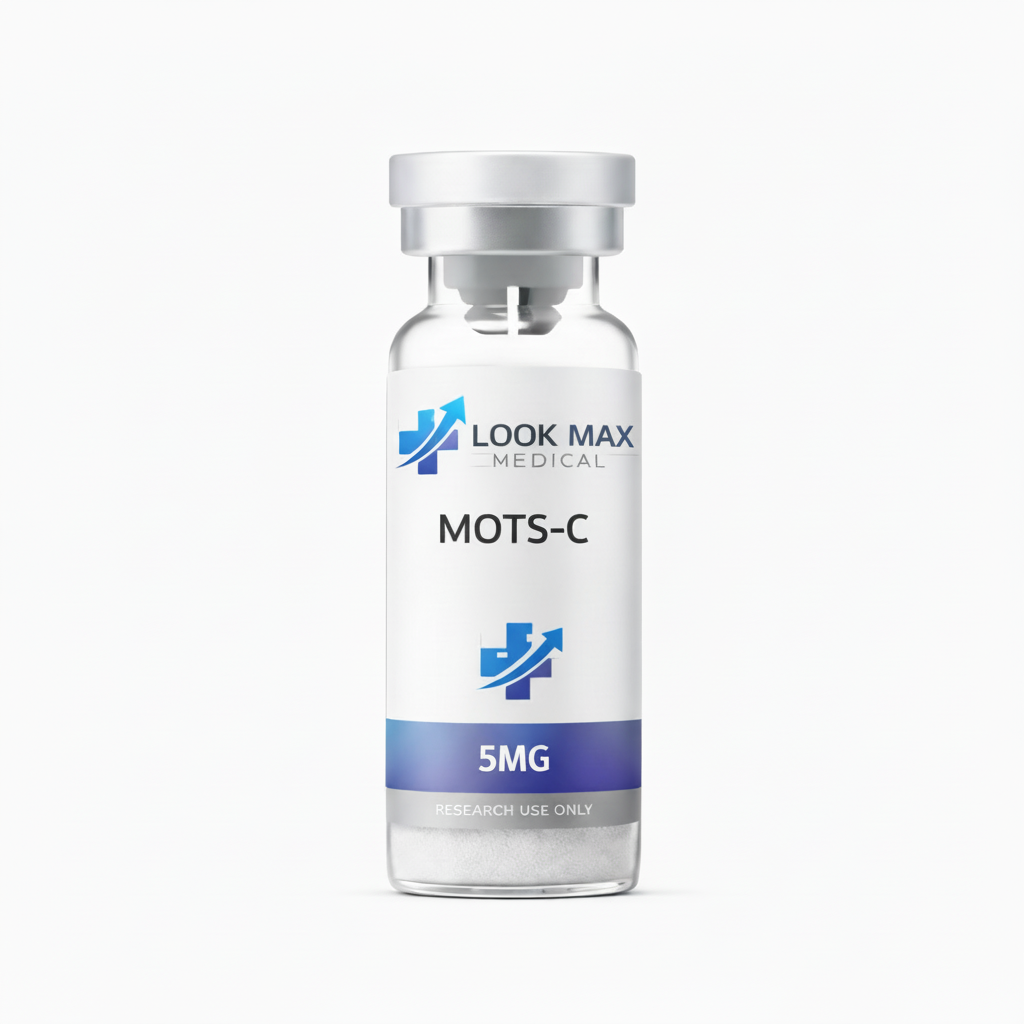
Description
MOTS-C — Research & Data
A mitochondrial-derived peptide that regulates metabolic homeostasis. MOTS-C targets the folate-methionine cycle and AMPK pathway, playing a role in exercise mimicry and metabolic regulation.
How MOTS-C Works
MOTS-C is encoded in the mitochondrial genome (12S rRNA gene) and acts as a retrograde signal from mitochondria to the nucleus. It activates AMPK by inhibiting the folate-methionine cycle, which depletes de novo purine biosynthesis. This triggers metabolic stress responses that improve glucose uptake and fatty acid oxidation.
Mechanisms of Action
AMPK Activation
Activates AMP-activated protein kinase, the master regulator of cellular energy homeostasis and metabolism.
Folate Cycle
Targets the folate-methionine cycle, influencing de novo purine synthesis and one-carbon metabolism.
Insulin Sensitivity
Improves glucose uptake and insulin sensitivity in skeletal muscle tissue.
What Research Has Shown
Preclinical studies show MOTS-C prevents age- and diet-induced insulin resistance in mice. Exercise increases circulating MOTS-C levels, suggesting it mediates some exercise benefits. MOTS-C levels decline with age, correlating with metabolic dysfunction. Human observational data links lower MOTS-C to obesity and diabetes.
Certificate of Analysis
Third Party Tested
Research Areas
Metabolism
MOTS-c prevents obesity and restores insulin sensitivity by enhancing metabolic flexibility.
Bone Health
MOTS-c treatment reduced bone loss in ovariectomized mice by inhibiting osteoclast formation.
Cardiovascular
MOTS-c levels correlate with endothelial function. Treatment reduced vascular calcification by 55%.
Immune Function
MOTS-c dramatically improved survival in MRSA-infected mice by enhancing macrophage bactericidal capacity.
Clinical Outcomes
Regulatory Status
Dosing Information from Research
Animal research uses 5–15 mg/kg intraperitoneally. Human-equivalent dosing is extrapolated at 5–10 mg subcutaneously, typically 3–5 times per week. No standardized human dosing protocols exist.
Pharmacokinetics
MOTS-C has a plasma half-life of approximately 2–4 hours in animal models. It is rapidly taken up by skeletal muscle and adipose tissue. MOTS-C can translocate to the nucleus to regulate gene expression.
How It Works in the Body
MOTS-C is released from mitochondria into the cytoplasm where it inhibits the folate cycle enzyme MTHFD2. This depletes purine synthesis intermediates, activating AMPK. Activated AMPK then promotes glucose uptake via GLUT4 translocation, enhances fatty acid oxidation, and inhibits lipogenesis. MOTS-C can also translocate to the nucleus to directly regulate stress-response gene expression.
Important Notes
- MOTS-C is the first mitochondrial-derived peptide shown to regulate nuclear gene expression.
- Circulating MOTS-C levels correlate with exercise capacity and metabolic health.
- MOTS-C is considered an ‘exercise mimetic’ — reproducing some metabolic benefits of physical activity.
Safety Profile from Research
What clinical studies report
MOTS-C has shown no toxicity in animal studies at research doses. No human clinical trials have been completed, so human safety data is limited to observational studies of endogenous MOTS-C levels.
Treatment Discontinuation Rates
Not applicable — no human clinical trials completed.
Study Exclusion Criteria
Planned human trials are expected to exclude patients with mitochondrial disorders, active malignancies, and uncontrolled diabetes.
Researcher Notes
- MOTS-C is best studied in metabolic and aging research contexts.
- Combine with exercise protocols to study synergistic metabolic effects.
- Blood MOTS-C levels can be measured via ELISA to correlate with metabolic outcomes.
Compound Information
Storage Requirements
Lyophilized
Store at -20°C. Stable at 2-8°C for up to 3 months.
Reconstituted
Use within 14 days at 2-8°C.
Light Sensitivity
Moderate. Store in opaque containers.
Research Status — Where It Stands
MOTS-C is a relatively new discovery (2015) with rapidly growing research interest. Preclinical data is promising for metabolic regulation and aging. No human clinical trials completed. Active area of investigation.


Reviews
There are no reviews yet.