
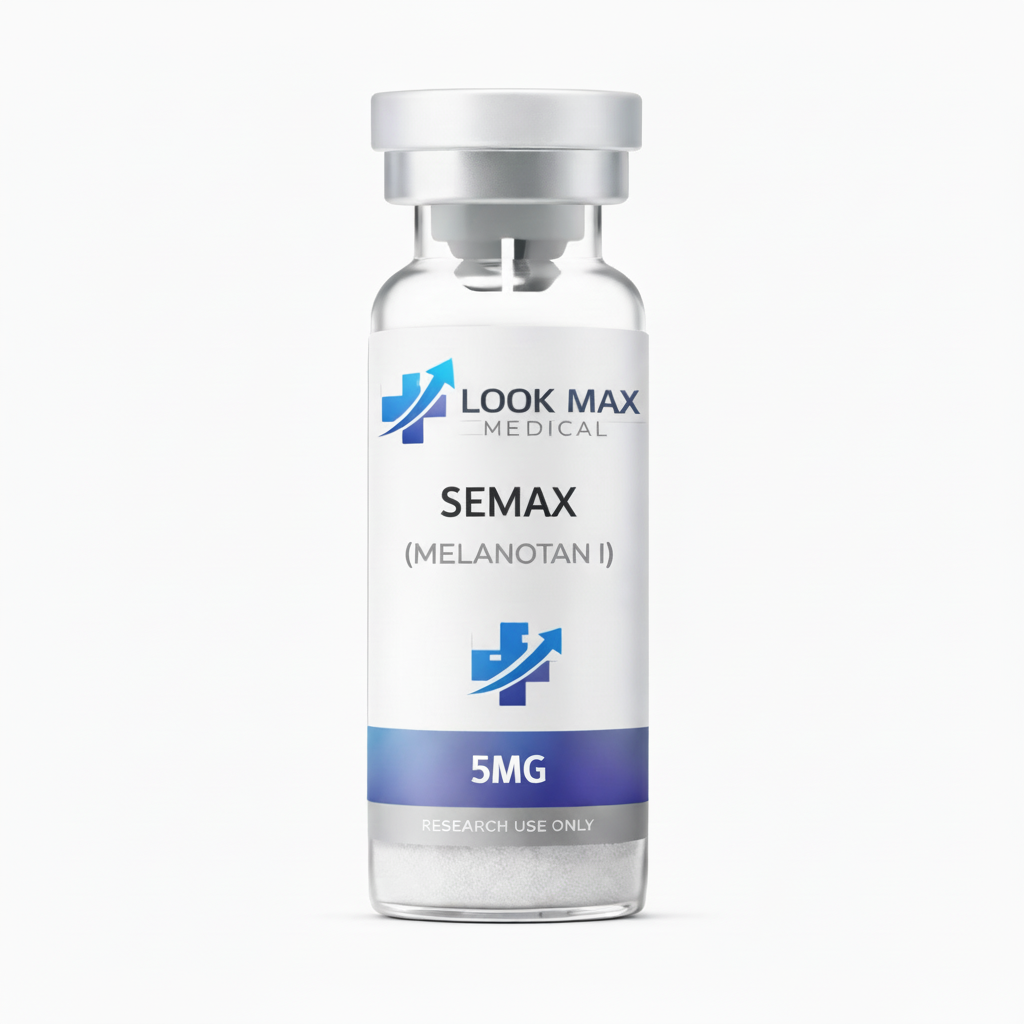
Description
Cognitive & Neuroprotective Peptide
SEMAX — Research & Data
A 7-amino acid synthetic heptapeptide analog of ACTH (4-10) that upregulates BDNF expression and modulates the TrkB signaling pathway, studied for cognitive enhancement and neuroprotection in clinical research. Premium Research Peptide. 🧠
How SEMAX Works
Semax is a synthetic analog of ACTH (4-10) extended with Pro-Gly-Pro at the C-terminus for enhanced stability and prolonged effects. It upregulates brain-derived neurotrophic factor (BDNF), activates the TrkB receptor pathway, and influences the expression of genes involved in neuroplasticity and vascular function. Unlike the parent ACTH hormone, Semax lacks hormonal activity but retains potent nootropic effects.
Mechanisms of Action
BDNF/TrkB Pathway
1.4-fold increase in BDNF protein levels and 1.6-fold increase in TrkB phosphorylation. Enhanced synaptic plasticity and learning. Primary mechanism of cognitive enhancement.
Melanocortin System
Potential interaction with melanocortin receptors. Modulates stress response pathways. May contribute to cognitive effects without hormonal activity.
Vascular Gene Expression
Upregulates vascular system genes including VEGF pathway. Promotes angiogenesis after ischemia. Supports neurovascular function and brain blood supply.
What Research Has Shown
Research conducted at the Institute of Molecular Genetics, Russian Academy of Sciences, demonstrated that intranasal Semax (50 mcg/kg) produces rapid and significant increases in neurotrophic factor expression in the rat hippocampus, with animals showing improved conditioned avoidance reactions. BDNF protein increased 1.4-fold, TrkB phosphorylation 1.6-fold, exon III BDNF mRNA 3-fold, and TrkB mRNA 2-fold. 100% of treated animals showed BDNF increases. Semax is approved in Russia as a 0.1% or 1% nasal spray for treating ischemic stroke, traumatic brain injury, and cognitive impairment.
Certificate of Analysis
Third Party Tested
Research Areas
Cognitive Enhancement
Semax enhances learning, memory, and attention through BDNF upregulation and TrkB pathway activation in the hippocampus.
Neuroprotection
Semax is approved in Russia for stroke treatment, demonstrating clinical efficacy in improving motor function and functional recovery.
Vascular Health
Semax promotes the expression of genes involved in vascular formation and function, supporting brain blood supply after injury.
Stress Response
As an ACTH analog, Semax may modulate stress response pathways through melanocortin receptor interactions without hormonal side effects.
Clinical Outcomes
Regulatory Status
Dosing Information from Research
Semax is administered intranasally in Russia as a 0.1% solution for cognitive enhancement or 1% solution for stroke treatment. Standard nootropic protocol: 200-600 mcg, 2-3x daily intranasal (0.1% solution, 2-3 drops per nostril), total daily dose 400-1,800 mcg for 10-14 days. Neuroprotection protocol: 2,000-6,000 mcg, 3-4x daily (1% solution) for stroke treatment. Research protocol: 50 mcg/kg single intranasal dose showed significant BDNF upregulation. The Pro-Gly-Pro extension increases the duration of effects to 20-24 hours compared to native ACTH fragments. Cycles may be repeated after 2-4 week breaks.
Pharmacokinetics
Semax has a plasma half-life of approximately 1-2 hours, but duration of effect extends to 20-24 hours due to the Pro-Gly-Pro C-terminal extension providing metabolic stability. Intranasal administration is preferred for rapid CNS delivery, crossing the blood-brain barrier readily. Poor oral bioavailability is typical for peptides. Subcutaneous administration is an alternative route.
How It Works in the Body
After intranasal administration, Semax crosses the blood-brain barrier and enters the CNS. It upregulates BDNF expression in the hippocampus — the brain region critical for memory and learning. The activated BDNF binds to TrkB receptors, triggering downstream signaling cascades that enhance synaptic plasticity, neuronal survival, and cognitive function. In ischemic conditions, Semax additionally upregulates vascular genes promoting angiogenesis and neurovascular repair.
Important Notes
- Semax is an ACTH (4-10) analog that lacks hormonal activity — no effect on cortisol or the HPA axis.
- The Pro-Gly-Pro C-terminal extension extends duration from minutes to 20-24 hours.
- Approved in Russia since the 1990s for stroke and cognitive impairment; not FDA-approved in the United States.
- Research compound status in most Western countries.
- Related peptide: Selank (tuftsin analog with anxiolytic properties).
Safety Profile from Research
What clinical studies report
Semax has been used clinically in Russia since the 1990s with a favorable safety profile. Unlike ACTH, it lacks hormonal activity and does not affect the hypothalamic-pituitary-adrenal axis. Most reported side effects are mild and localized to the administration site.
Common Digestive Issues
Nasal irritation (~10%), mild headache (~8%), dizziness (~5%), and taste disturbance (~3%) are the most commonly reported side effects.
Treatment Discontinuation Rates
Well-tolerated across 0.1% and 1% solution formulations. No dependence observed in clinical use. No withdrawal symptoms reported. Breaks down into natural amino acids.
Study Exclusion Criteria
Limited Western clinical trial data. Not studied in pregnancy or breastfeeding. Caution in patients with history of seizures. Drug interactions not extensively characterized.
Researcher Notes
- Decades of clinical use in Russia supports safety profile.
- No hormonal side effects unlike parent ACTH molecule.
- Most side effects are mild and transient.
- Well-tolerated in stroke patient populations.
- Intranasal administration optimal for CNS delivery — poor oral bioavailability.
Compound Information
Storage Requirements
Lyophilized
Store at -20°C. Protect from light.
Reconstituted
Store at 2-8°C. Use within 4 weeks.
Light Sensitivity
Light sensitive and temperature sensitive. Store in original container.
Research Status — Where It Stands
Semax was developed at the Institute of Molecular Genetics of the Russian Academy of Sciences. Approved in Russia since the 1990s for ischemic stroke, traumatic brain injury, and cognitive impairment. Available as 0.1% and 1% nasal spray formulations. Not FDA-approved in the United States. Research compound status in most Western countries. Related peptide Selank (tuftsin analog) was developed by the same institute.
Published Studies
BDNF and TrkB Expression in Rat Hippocampus
2006
A single intranasal application of Semax (50 mcg/kg) produced 3-fold increase in exon III BDNF mRNA and 2-fold increase in trkB mRNA levels in rat hippocampus.
Vascular Gene Expression in Focal Ischemia
2014
Semax influences the expression of genes that promote the formation and functioning of the vascular system in focal brain ischemia, supporting recovery after stroke.
Clinical Efficacy in Ischemic Stroke
2018
Early rehabilitation with Semax increases plasma BDNF, speeds functional recovery, and improves motor performance in ischemic stroke patients.
Temporal Dynamics of NGF and BDNF
2010
Compared NGF and BDNF gene expression dynamics in hippocampus, frontal cortex, and retina under Semax action.
BDNF and trkB expression in rat hippocampus after Semax
2006
Single intranasal Semax (50 mcg/kg) produced 3-fold BDNF mRNA and 2-fold trkB mRNA increase in hippocampus.
Vascular gene expression in rat brain focal ischemia
2014
Semax influences expression of genes promoting vascular formation and function after focal ischemia.
Efficacy of Semax in ischemic stroke treatment
2018
Early rehabilitation with Semax increases plasma BDNF and improves motor performance in stroke patients.
NGF and BDNF gene expression dynamics under Semax
2010
Characterized temporal dynamics of neurotrophic factor expression across brain regions.
Novel insights into ACTH(4-7)PGP (Semax) protective properties
2020
Comprehensive molecular-level analysis of Semax protective mechanisms.

Reviews
There are no reviews yet.