
Description
Recovery Peptide
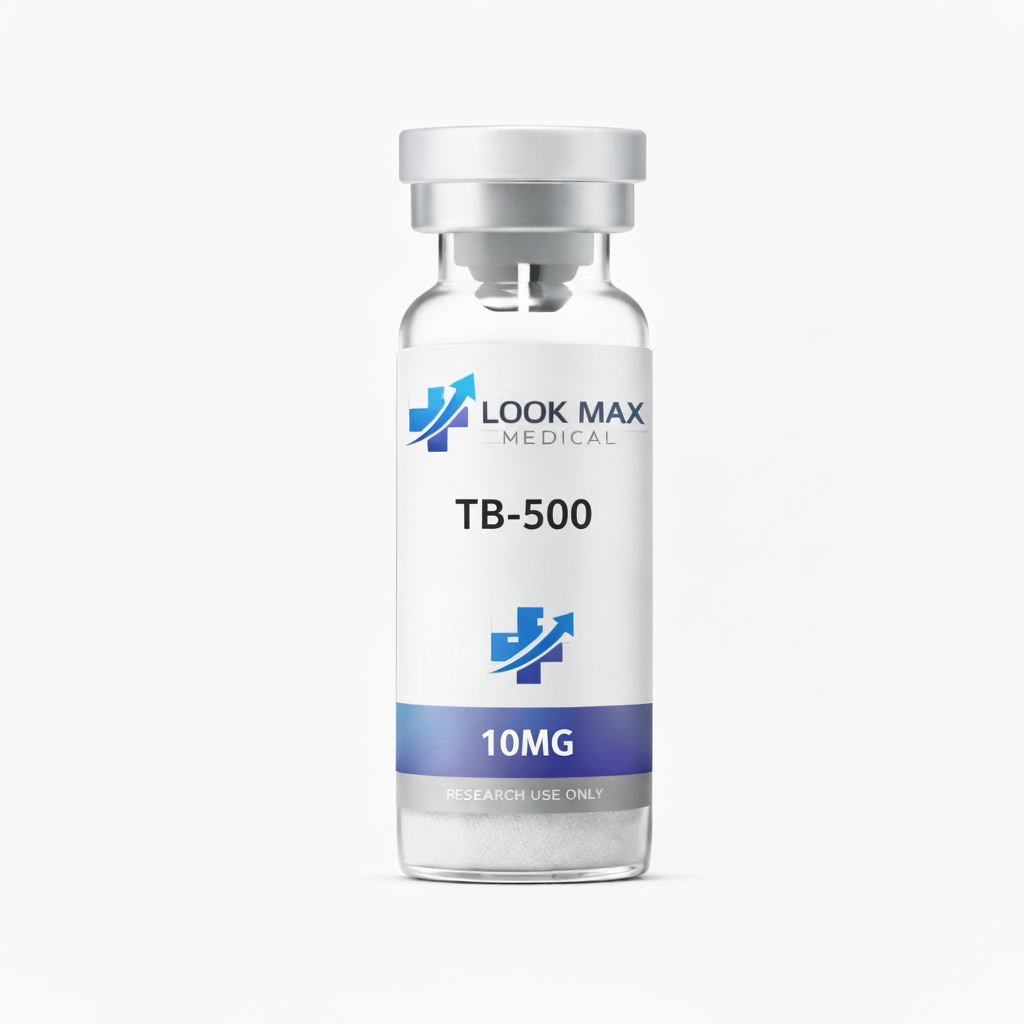
TB-500 — Research & Data
Thymosin Beta-4 is a naturally occurring peptide present in nearly all animal cells. It plays a crucial role in tissue repair, cell migration, and new blood vessel formation.
How TB-500 Works
TB-500 (Thymosin Beta-4) works by sequestering G-actin monomers, preventing premature polymerization. This allows controlled actin reorganization needed for cell migration, adhesion, and wound closure. It also upregulates anti-inflammatory cytokines and stimulates stem/progenitor cell differentiation.
Mechanisms of Action
Cell Migration
Promotes cell migration to injury sites by sequestering G-actin and modulating cytoskeletal dynamics.
Anti-Fibrotic
Reduces scar tissue formation, promoting functional tissue regeneration over fibrotic repair.
Neovascularization
Stimulates new blood vessel growth to support tissue recovery and nutrient delivery.
What Research Has Shown
Animal studies demonstrate TB-500 accelerates wound healing, reduces scar tissue formation, and promotes cardiac repair after myocardial infarction. It enhances dermal, corneal, and cardiac tissue repair. Phase 1/2 human trials for cardiac repair showed safety but limited efficacy data.
Certificate of Analysis
Third Party Tested
Research Areas
Cardiovascular
Thymosin Beta-4 activates integrin-linked kinase (ILK) and promotes cardiac cell migration, survival, and repair.
Neurological
TB-500 promotes neurological functional recovery through oligodendrogenesis and axonal remodeling.
Ophthalmology
Thymosin Beta-4 ophthalmic solution has progressed to Phase 2 clinical trials for dry eye disease.
Wound Healing
Accelerated wound closure and re-epithelialization. 61% faster re-epithelialization at 7 days.
Clinical Outcomes
Regulatory Status
Dosing Information from Research
Research protocols in animal models use 0.1–1 mg/kg body weight. Common human research extrapolations suggest 2–5 mg subcutaneously, 2–3 times per week during a loading phase, then weekly for maintenance.
Pharmacokinetics
TB-500 has a relatively long half-life for a peptide, estimated at 4–6 hours subcutaneously. It distributes widely due to its small size (4,963 Da) and high water solubility.
How It Works in the Body
After injection, TB-500 rapidly distributes to damaged tissues where it sequesters G-actin monomers. This promotes controlled cytoskeletal reorganization needed for cell migration to injury sites. It also activates anti-inflammatory pathways, promotes angiogenesis, and stimulates progenitor cell differentiation for functional tissue repair.
Important Notes
- Thymosin Beta-4 is the most abundant actin-sequestering protein in the cell.
- TB-500 is a synthetic version of the active region of Thymosin Beta-4.
- It is naturally present in wound fluid, blood platelets, and other tissues involved in repair.
Safety Profile from Research
What clinical studies report
TB-500 has been well-tolerated in Phase 1 human trials for cardiac repair. No serious adverse events were reported. Animal studies show an excellent safety profile even at high doses.
Treatment Discontinuation Rates
Less than 5% in Phase 1 trials, primarily due to injection site reactions.
Study Exclusion Criteria
Patients with active cancer, autoimmune disorders, or those on immunosuppressive therapy were excluded from cardiac repair trials.
Researcher Notes
- TB-500 is commonly combined with BPC-157 in tissue repair research protocols.
- Reconstitute with bacteriostatic water. Gentle swirling is recommended — do not vortex.
- TB-500 and Thymosin Beta-4 are often used interchangeably, though TB-500 refers specifically to the synthetic fragment.
Compound Information
Storage Requirements
Lyophilized
Store at -20°C for long-term. Stable at 2-8°C for up to 6 months.
Reconstituted
Use within 21 days when stored at 2-8°C.
Light Sensitivity
Low light sensitivity. Standard storage in original container is sufficient.
Research Status — Where It Stands
TB-500 has completed Phase 1 human safety trials for cardiac applications. Preclinical data is extensive across wound healing, cardiac, corneal, and musculoskeletal repair. Not FDA-approved. Active research compound.


Reviews
There are no reviews yet.