
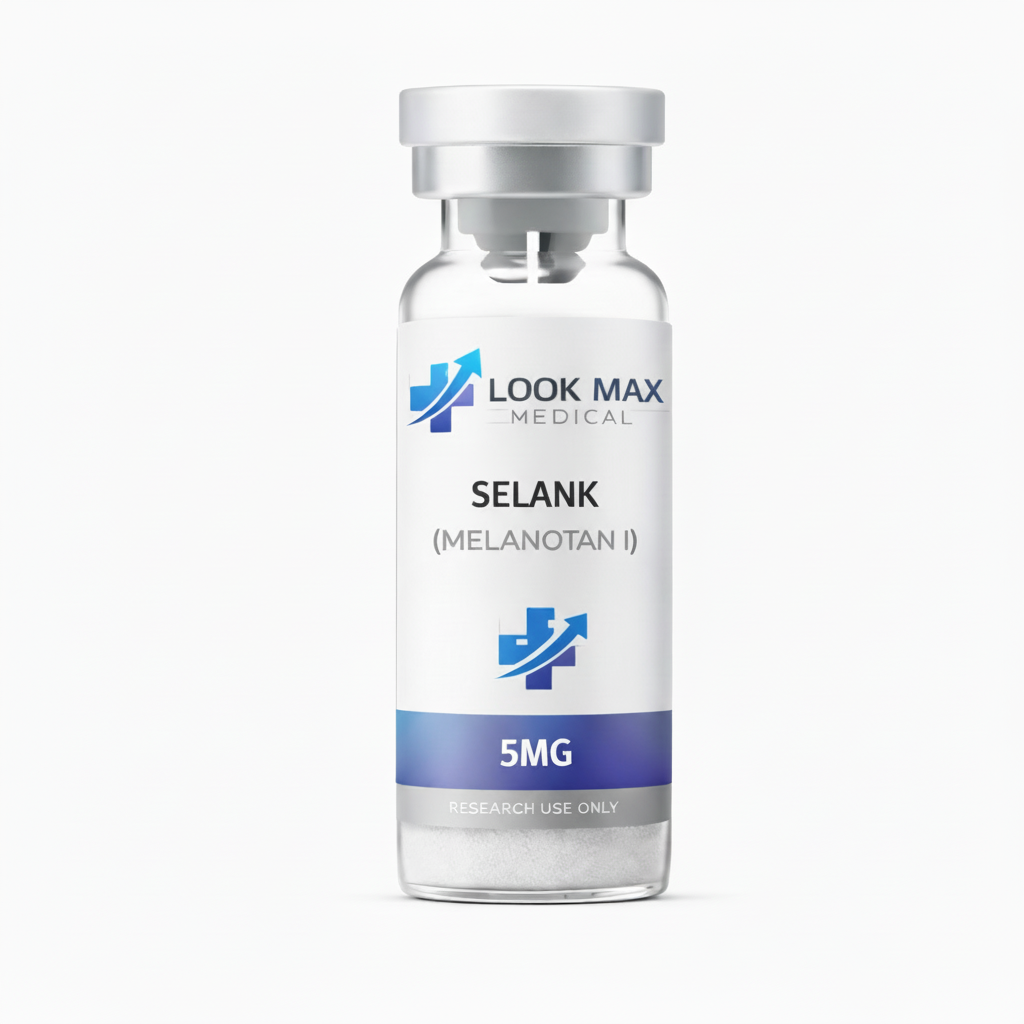
Description
SELANK — Research & Data
A synthetic heptapeptide analog of the immunomodulatory peptide tuftsin, extended with a Pro-Gly-Pro C-terminal sequence for enhanced metabolic stability. Developed at the Institute of Molecular Genetics of the Russian Academy of Sciences, Selank modulates GABA-ergic neurotransmission and influences the expression of BDNF, serotonin, and enkephalin genes. It is approved in Russia as an anxiolytic nasal spray.
How SELANK Works
Selank is derived from tuftsin (Thr-Lys-Pro-Arg), a naturally occurring immunomodulatory tetrapeptide, extended with Pro-Gly-Pro at the C-terminus. It enhances GABA-mediated inhibitory neurotransmission in the CNS, producing anxiolytic and nootropic effects. Unlike benzodiazepines, Selank does not produce sedation, motor impairment, or tolerance. It also upregulates BDNF and enkephalin gene expression, supporting neuroplasticity and mood regulation.
Mechanisms of Action
GABA-ergic Modulation
Selank enhances GABA-ergic inhibitory neurotransmission, producing anxiolytic effects comparable to benzodiazepines but without sedation, tolerance, or dependence.
Neurotrophic Factor Expression
Upregulates BDNF mRNA expression up to 2.4-fold in the hippocampus and modulates NGF expression in the frontal cortex, supporting neuroplasticity.
Enkephalin System
Stabilizes enkephalin degradation and modulates the endogenous opioid system, contributing to mood regulation and stress resilience without addictive properties.
What Research Has Shown
In a clinical study of 62 patients with generalized anxiety disorder, Selank nasal spray demonstrated anxiolytic efficacy comparable to medazepam (a benzodiazepine), with 58% improvement on the Hamilton Anxiety Scale. Importantly, Selank showed no sedative effects, no cognitive impairment, and no withdrawal symptoms upon discontinuation. Preclinical studies demonstrate 2.4-fold BDNF mRNA upregulation and significant modulation of serotonin metabolism genes.
Certificate of Analysis
Third Party Tested
Research Areas
Anxiety & Mood
Selank demonstrated anxiolytic efficacy comparable to benzodiazepines in GAD patients without sedation, tolerance, or dependence.
Cognitive Enhancement
Upregulates BDNF mRNA 2.4-fold in hippocampus. Modulates NGF expression in frontal cortex for neuroplasticity support.
Immune Modulation
Derived from tuftsin, Selank retains immunomodulatory properties. Influences IL-6 expression and immune cell function.
Enkephalin System
Modulates proenkephalin gene expression in hippocampus, contributing to mood regulation and stress resilience.
Clinical Outcomes
Regulatory Status
Dosing Information from Research
Selank is administered intranasally in Russia as a 0.15% solution. Standard anxiolytic protocol: 250-500 mcg, 2-3 times daily intranasal for 14-21 days. Treatment courses may be repeated after a 1-2 week break. Preclinical studies typically use 250-300 mcg/kg. Subcutaneous administration is an alternative route used in research.
Pharmacokinetics
Selank has a plasma half-life of approximately 1-3 minutes for the parent compound, but the Pro-Gly-Pro extension generates bioactive metabolites with extended duration of effect (up to 24 hours). Intranasal bioavailability is high due to rapid absorption through nasal mucosa. The peptide crosses the blood-brain barrier readily via the intranasal route.
How It Works in the Body
After intranasal administration, Selank is rapidly absorbed through the nasal mucosa into the CNS. It binds to GABA receptor complexes, enhancing inhibitory neurotransmission. Simultaneously, it enters the hippocampus where it upregulates BDNF and NGF gene expression, promoting synaptic plasticity. The tuftsin core provides immunomodulatory activity, while the PGP extension ensures metabolic stability. Selank also modulates serotonin (5-HT) metabolism and enkephalin gene expression.
Important Notes
- Selank is a tuftsin analog — distinct from Semax (which is an ACTH analog).
- Approved in Russia as an anxiolytic since the 2000s; not FDA-approved.
- Produces anxiolytic effects comparable to benzodiazepines but without sedation, tolerance, or dependence.
- The Pro-Gly-Pro extension (shared with Semax) provides metabolic stability.
- Both Selank and Semax were developed at the same Russian institute and are sometimes used in combination.
Safety Profile from Research
What clinical studies report
Selank demonstrated an excellent safety profile in clinical trials. No sedation, no motor impairment, no cognitive impairment, and no withdrawal symptoms were observed. It does not produce tolerance or dependence even with repeated use.
Common Digestive Issues
Nasal irritation (~5%) and mild headache (~3%) are the most commonly reported side effects. No significant systemic adverse effects reported.
Treatment Discontinuation Rates
No withdrawal symptoms reported upon discontinuation in clinical trials. No tolerance development observed.
Study Exclusion Criteria
Severe psychiatric disorders requiring hospitalization, active substance abuse, pregnancy, and breastfeeding were typical exclusion criteria.
Researcher Notes
- Selank’s lack of sedation and dependence makes it a notable contrast to benzodiazepines.
- BDNF upregulation suggests potential cognitive benefits beyond anxiolysis.
- Intranasal administration is strongly preferred for CNS delivery.
- Consider combining Selank (anxiolytic) with Semax (nootropic) for complementary cognitive and mood effects — both use the same PGP stabilization.
Compound Information
Storage Requirements
Lyophilized
Store at -20°C. Protect from light.
Reconstituted
Store at 2-8°C. Use within 4 weeks.
Light Sensitivity
Light sensitive. Store in original container away from direct light.
Research Status — Where It Stands
Selank is approved in Russia as a 0.15% anxiolytic nasal spray. Developed at the Institute of Molecular Genetics of the Russian Academy of Sciences (same institute as Semax). Not FDA-approved in the United States. Research compound status in most Western countries. Over 50 published studies support its anxiolytic and nootropic properties.


Reviews
There are no reviews yet.