
Description
Growth Hormone Releasing Peptide
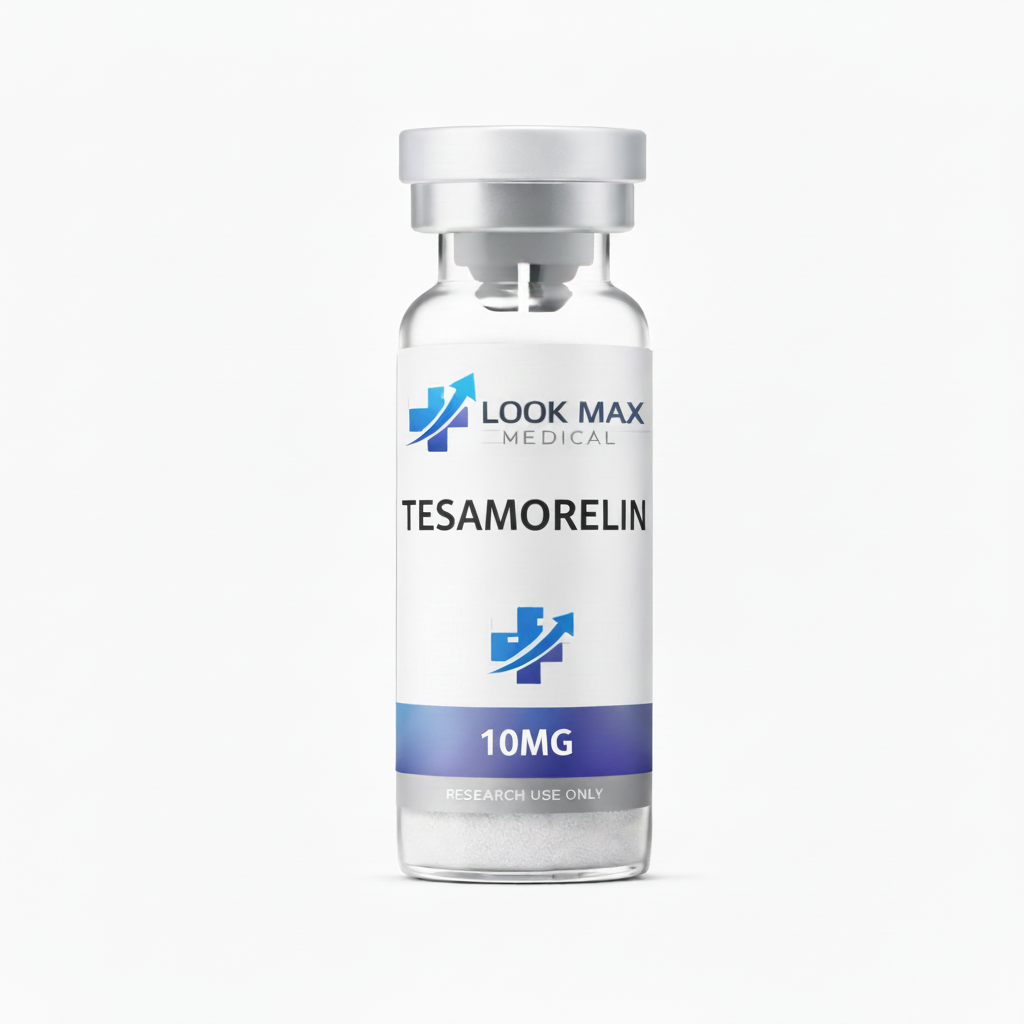
Tesamorelin — Research & Data
A synthetic analog of growth hormone-releasing hormone (GHRH) that stimulates the pituitary gland to produce and release growth hormone. FDA-approved for HIV-associated lipodystrophy.
How Tesamorelin Works
Tesamorelin binds to GHRH receptors on pituitary somatotroph cells, stimulating synthesis and pulsatile release of endogenous growth hormone. This preserves the hypothalamic-pituitary feedback axis, unlike exogenous GH which suppresses endogenous production. The resulting GH elevation increases hepatic IGF-1 production.
Mechanisms of Action
GHRH Analog
Binds pituitary GHRH receptors to stimulate pulsatile growth hormone release, preserving natural feedback loops.
Lipid Metabolism
Reduces visceral adipose tissue by enhancing lipolysis and improving lipid profiles including triglycerides.
IGF-1 Elevation
Increases circulating IGF-1 levels, supporting tissue repair, muscle maintenance, and metabolic function.
What Research Has Shown
Phase 3 trials in 816 HIV-lipodystrophy patients showed 15.4% reduction in visceral adipose tissue at 26 weeks. Triglycerides improved. A separate study in 61 cognitively normal older adults showed improved executive function and verbal memory. IGF-1 levels increased by 50–100% from baseline.
Dosing Information from Research
FDA-approved dose: 2 mg subcutaneously once daily. Clinical trials used this fixed dose. Research protocols follow the 2 mg daily regimen. Injection site rotation is recommended (abdomen).
Pharmacokinetics
Tesamorelin has a half-life of 26–38 minutes after subcutaneous injection. Peak GH release occurs 15–45 minutes post-injection. Despite short peptide half-life, the GH release effect persists for several hours. Daily dosing maintains elevated IGF-1 levels.
How It Works in the Body
After subcutaneous injection, tesamorelin rapidly reaches the pituitary gland where it binds GHRH receptors. This triggers a pulse of GH release mimicking natural physiology. GH then travels to the liver, stimulating IGF-1 production. IGF-1 mediates the downstream effects: lipolysis of visceral fat, improved lipid profiles, and tissue repair signaling.
Important Notes
- Tesamorelin is FDA-approved (brand name: Egrifta®) for HIV-associated lipodystrophy.
- It preserves natural GH pulsatility, unlike exogenous GH administration.
- IGF-1 levels should be monitored during research protocols to ensure they remain within physiological range.
- Effects reverse upon discontinuation — VAT tends to re-accumulate.
Safety Profile from Research
What clinical studies report
Well-characterized safety profile from Phase 3 trials with 816 patients. Most adverse events were mild. Injection site reactions (erythema, pruritus) were the most common (8.5% vs 2.3% placebo).
Common Digestive Issues
Nausea was reported in 4.5% of patients vs 3.2% placebo. Generally mild and transient.
⚠️ Theoretical Concern — IGF-1 Elevation and Cancer Risk
Elevated IGF-1 has been theoretically associated with cancer risk in epidemiological studies. Clinical trials have not shown increased cancer incidence, but monitoring IGF-1 levels is recommended.
Treatment Discontinuation Rates
8.5% in Phase 3 trials, similar to placebo (7.9%). Primary reasons: injection site reactions and patient preference.
Study Exclusion Criteria
Patients with active malignancy, pituitary disease, hypothalamic disorders, head irradiation history, or HbA1c >8% were excluded.
Researcher Notes
- Tesamorelin is one of the few FDA-approved GHRH analogs available for research.
- The cognitive function data (improved executive function in elderly) is an emerging area of interest.
- Unlike GHRP-6 or hexarelin, tesamorelin does not significantly increase cortisol or prolactin.
- Morning dosing on an empty stomach may optimize GH release based on clinical trial protocols.
Compound Information
Storage Requirements
Lyophilized
Store at 2-8°C. Do not freeze. Protect from light.
Reconstituted
Use within 14 days when stored at 2-8°C.
Light Sensitivity
Light-sensitive. Store in original carton until use.
Research Status — Where It Stands
FDA-approved (Egrifta®/Egrifta SV®) for HIV-associated lipodystrophy since 2010. Ongoing research for cognitive function, liver fat reduction (NAFLD/NASH), and general metabolic applications.


Reviews
There are no reviews yet.