
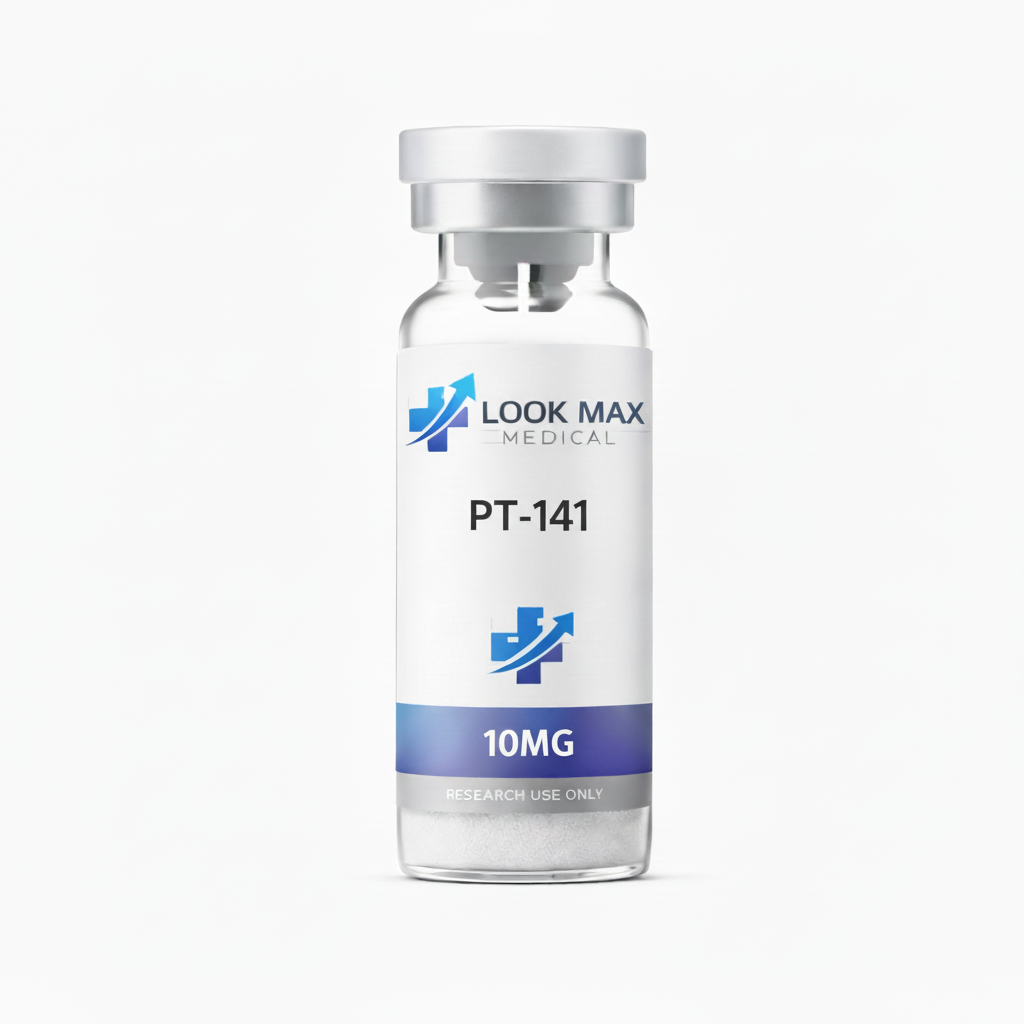
Description
PT-141 — Research & Data
PT-141 (Bremelanotide) is a cyclic heptapeptide melanocortin receptor agonist derived from Melanotan II. It is the only FDA-approved peptide for hypoactive sexual desire disorder (HSDD) in premenopausal women, marketed as Vyleesi®. Unlike PDE5 inhibitors, PT-141 acts centrally through melanocortin-4 receptors (MC4R) in the hypothalamus, modulating sexual arousal pathways in the brain.
How PT-141 Works
PT-141 is a cyclic lactam analog of α-MSH that crosses the blood-brain barrier and activates MC4 receptors in the medial preoptic area of the hypothalamus. This triggers a cascade involving dopamine release in the mesolimbic pathway and oxytocin release from the paraventricular nucleus, both critical for sexual arousal and motivation. Unlike vascular-targeted treatments, PT-141 addresses desire at its neurological origin.
Mechanisms of Action
MC4R Activation
PT-141 activates melanocortin-4 receptors in the hypothalamus, triggering downstream dopaminergic and oxytocinergic pathways involved in sexual arousal and desire.
Central vs Peripheral Action
Unlike PDE5 inhibitors (sildenafil, tadalafil) that act on vascular smooth muscle, PT-141 acts in the CNS on neural circuits governing desire and arousal.
Melanocortin System
As a non-selective melanocortin agonist, PT-141 also has affinity for MC1R (pigmentation) and MC3R (energy homeostasis), though MC4R mediates the sexual function effects.
What Research Has Shown
The RECONNECT Phase 3 program (two studies, 1,247 premenopausal women) demonstrated statistically significant improvements in sexual desire and reduction in distress scores vs placebo. In male studies, intranasal PT-141 induced erections in 8 of 10 men with erectile dysfunction, including some who had failed sildenafil. The FDA approved bremelanotide (Vyleesi®) in June 2019 for HSDD in premenopausal women.
Certificate of Analysis
Third Party Tested
Research Areas
Female Sexual Dysfunction
FDA-approved (Vyleesi®) for HSDD in premenopausal women. RECONNECT trials showed significant improvement in desire and reduced distress.
Male Erectile Dysfunction
PT-141 induced erections in men who failed sildenafil, demonstrating a novel central mechanism independent of PDE5 inhibition.
Melanocortin Pharmacology
PT-141 acts centrally through MC4R in the hypothalamus, triggering dopamine and oxytocin release for sexual arousal modulation.
Clinical Outcomes
Regulatory Status
Dosing Information from Research
FDA-approved dosing (Vyleesi®): 1.75 mg subcutaneous injection, administered at least 45 minutes before anticipated sexual activity. No more than one dose per 24 hours and no more than 8 doses per month. Research protocols have used intranasal and IV routes at varying doses. Blood pressure monitoring is recommended.
Pharmacokinetics
Subcutaneous bremelanotide reaches peak plasma concentration (Cmax) in approximately 1 hour. The elimination half-life is approximately 2.7 hours. Bioavailability is approximately 100% via subcutaneous route. Effects onset within 45 minutes and may persist for up to 12 hours. Hepatic metabolism via CYP enzymes.
How It Works in the Body
After subcutaneous injection, PT-141 enters systemic circulation and crosses the blood-brain barrier. In the hypothalamus, it binds to MC4 receptors, activating intracellular cAMP signaling. This stimulates dopaminergic neurons in the ventral tegmental area and triggers oxytocin release from the paraventricular nucleus. The combined dopamine-oxytocin signaling cascade modulates sexual motivation and arousal circuits. Peripheral effects include transient blood pressure increases due to melanocortin receptor activation.
Important Notes
- PT-141 (bremelanotide) is FDA-approved as Vyleesi® — one of few peptides with full regulatory approval.
- It works through a completely different mechanism than PDE5 inhibitors (Viagra, Cialis).
- Blood pressure should be monitored — transient increases of 6-12 mmHg systolic are common.
- Nausea is the most common side effect (76% incidence in trials) and usually resolves within 2 hours.
- Use is limited to 8 doses per month per FDA labeling.
Safety Profile from Research
What clinical studies report
In the RECONNECT trials, the most common adverse reactions were nausea (40% vs 1% placebo), flushing (20%), injection site reactions (13%), headache (11%), and transient hypertension. Nausea was typically mild-to-moderate and resolved within 2 hours.
Common Digestive Issues
Nausea occurs in approximately 40% of patients at the approved dose (76% at higher research doses). Anti-emetic pretreatment may be considered. Vomiting occurs in approximately 5%.
⚠️ Theoretical Concern — Cardiovascular Effects
PT-141 causes transient blood pressure increases (6-12 mmHg systolic, 3-6 mmHg diastolic). It is contraindicated in uncontrolled hypertension or cardiovascular disease. Blood pressure should be monitored.
Treatment Discontinuation Rates
Approximately 7% in the RECONNECT trials, primarily due to nausea.
Study Exclusion Criteria
Uncontrolled hypertension (>160/100 mmHg), cardiovascular disease, hepatic impairment, pregnancy, and concomitant use of naltrexone were exclusion criteria.
Researcher Notes
- PT-141 is one of the few peptides with full FDA approval — significant regulatory validation.
- The central mechanism of action (MC4R) makes it unique among sexual function compounds.
- Nausea can be mitigated with anti-emetic pretreatment in research protocols.
- Blood pressure monitoring is essential — transient hypertension is a known pharmacological effect.
- Focal hyperpigmentation has been reported with repeated use due to MC1R activation.
Compound Information
Storage Requirements
Lyophilized
Store at -20°C for long-term. Stable at 2-8°C for up to 6 months.
Reconstituted
Use within 30 days when stored at 2-8°C.
Light Sensitivity
Protect from direct light. Store in original container.
Research Status — Where It Stands
FDA-approved as Vyleesi® (bremelanotide) in June 2019 for HSDD in premenopausal women. This represents one of the most significant regulatory milestones in peptide therapeutics. Continued research explores applications in male sexual dysfunction and other melanocortin-mediated conditions.


Reviews
There are no reviews yet.