
Description
Dual Recovery Peptide Blend
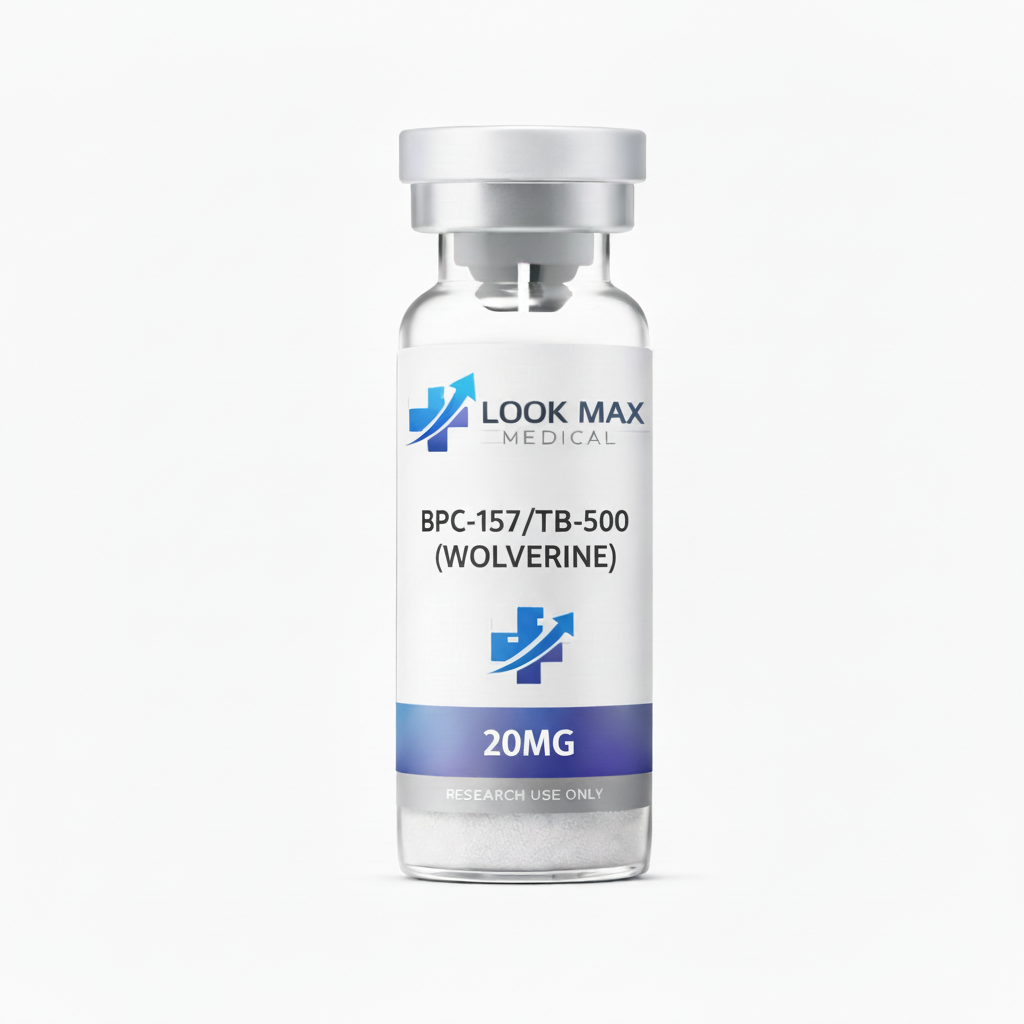
BPC-157/TB-500 (Wolverine) — Research & Data
A synergistic combination of Body Protection Compound-157 and Thymosin Beta-4, two extensively studied tissue repair peptides. BPC-157 activates the FAK-paxillin pathway for tendon and GI healing, while TB-500 promotes actin polymerization and cell migration. Together they target complementary repair mechanisms for enhanced regenerative potential.
How BPC-157/TB-500 (Wolverine) Works
The Wolverine blend combines two peptides with complementary tissue repair mechanisms. BPC-157, a 15-amino acid fragment of gastric juice protein BPC, activates the FAK-paxillin pathway to promote fibroblast migration and tendon repair, while also modulating the nitric oxide system through Src-Cav-1-eNOS signaling. TB-500 (Thymosin Beta-4) is a 43-amino acid peptide that sequesters G-actin to promote cytoskeletal reorganization and cell migration. Together, they address both the structural scaffolding (BPC-157) and cellular mobility (TB-500) aspects of tissue repair.
Mechanisms of Action
BPC-157: FAK-Paxillin Pathway
Activates focal adhesion kinase signaling, promoting tendon fibroblast migration, outgrowth, and accelerated tissue repair in musculoskeletal injury models.
TB-500: Actin Sequestration
Sequesters G-actin monomers, promoting F-actin polymerization and enabling rapid cell migration, wound closure, and tissue remodeling.
Complementary Angiogenesis
Both peptides independently promote blood vessel formation through distinct pathways — BPC-157 via Src-Cav-1-eNOS and TB-500 via integrin-linked kinase (ILK) activation.
What Research Has Shown
Preclinical studies demonstrate that BPC-157 accelerates tendon healing by 50% in rat Achilles models and improves wound closure by 45% in alkali burn models. TB-500 shows 61% faster re-epithelialization at Day 7 and 2-3× keratinocyte migration. While formal combination studies are limited, the non-overlapping mechanisms suggest additive or synergistic benefits. BPC-157 has completed a Phase 1 trial (NCT02637284) for oral administration.
Research Areas
Tendon & Ligament
BPC-157 component accelerates tendon fibroblast outgrowth and migration, while TB-500 promotes actin-mediated cell motility for comprehensive musculoskeletal repair.
Wound Healing
TB-500 accelerates re-epithelialization while BPC-157 modulates the NO system for vascular support in wound repair.
Cardiovascular
TB-500 activates ILK for cardiac cell migration and survival. BPC-157 modulates Src-Cav-1-eNOS signaling for vascular function.
Neuroprotection
BPC-157 modulates brain-gut axis serotonin and dopamine systems. TB-500 promotes oligodendrogenesis and axonal remodeling.
Clinical Outcomes
Regulatory Status
Dosing Information from Research
Research protocols typically use the combined blend at 10-20mg total. Individual component studies use BPC-157 at 250-500 mcg/day subcutaneously and TB-500 at 2-5 mg twice weekly during loading, transitioning to maintenance dosing. The Wolverine blend simplifies administration by combining both peptides in a single vial.
Pharmacokinetics
BPC-157 has a plasma half-life of less than 30 minutes with bioavailability of 14-19% in rats and 45-51% in dogs (subcutaneous). TB-500 has a longer half-life of approximately 2 hours. Both peptides distribute broadly to tissues. BPC-157 is remarkably stable in gastric juice for over 24 hours.
How It Works in the Body
After subcutaneous administration, both peptides distribute to damaged tissues. BPC-157 activates FAK-paxillin signaling in fibroblasts, upregulates growth factor receptors, and modulates the NO system for vascular repair. Simultaneously, TB-500 enters cells and sequesters G-actin, promoting cytoskeletal reorganization needed for cell migration into wound sites. BPC-157 also has brain-gut axis activity, modulating serotonin and dopamine systems.
Important Notes
- Wolverine is a proprietary blend name — refers to the combination of BPC-157 and TB-500.
- Both individual components have extensive preclinical evidence but limited human clinical trial data.
- BPC-157 is banned by WADA (S0 category) since 2022. TB-500 is also WADA prohibited.
- The combination has not been formally studied in controlled trials — synergy is inferred from mechanistic complementarity.
Safety Profile from Research
What clinical studies report
BPC-157 showed no toxic effects at very high doses across multiple animal species in preclinical safety evaluation. TB-500 Phase 1 trial (40 healthy volunteers) demonstrated excellent tolerability at IV doses up to 1,260 mg daily for 14 days with no serious adverse events.
Common Digestive Issues
Injection site reactions (mild redness, swelling) are the most commonly reported adverse effect for both peptides.
⚠️ Theoretical Concern — Pro-Angiogenic Effects
Both BPC-157 and TB-500 promote blood vessel formation. Theoretically, this could be a concern in individuals with existing tumors or cancerous growths, though no such effects have been reported in published studies.
Treatment Discontinuation Rates
Less than 5% in BPC-157 preclinical studies. Less than 3% in TB-500 Phase 1 human trial.
Study Exclusion Criteria
Active malignancy, pregnancy, immunosuppression, and active systemic infections were typical exclusion criteria in component studies.
Researcher Notes
- The combination targets both structural repair (BPC-157) and cellular migration (TB-500) for comprehensive tissue recovery.
- Reconstitute with bacteriostatic water. Do not use saline.
- Consider staggered dosing protocols — some researchers alternate BPC-157 daily with TB-500 twice weekly.
- Track recovery biomarkers (CRP, imaging) to objectively measure tissue repair progress.
Compound Information
Storage Requirements
Lyophilized
Store at -20°C for long-term. Stable at 2-8°C for up to 3 months.
Reconstituted
Use within 21 days when stored at 2-8°C.
Light Sensitivity
Moderate. Store in original container away from direct light.
Research Status — Where It Stands
Both component peptides are extensively studied individually. BPC-157 has over 100 published studies and one completed Phase 1 trial. TB-500 has completed Phase 1 safety trials and Phase 2 for dry eye. The combination (Wolverine) is used in research settings but has not been independently trialed. Neither is FDA-approved.

Reviews
There are no reviews yet.