
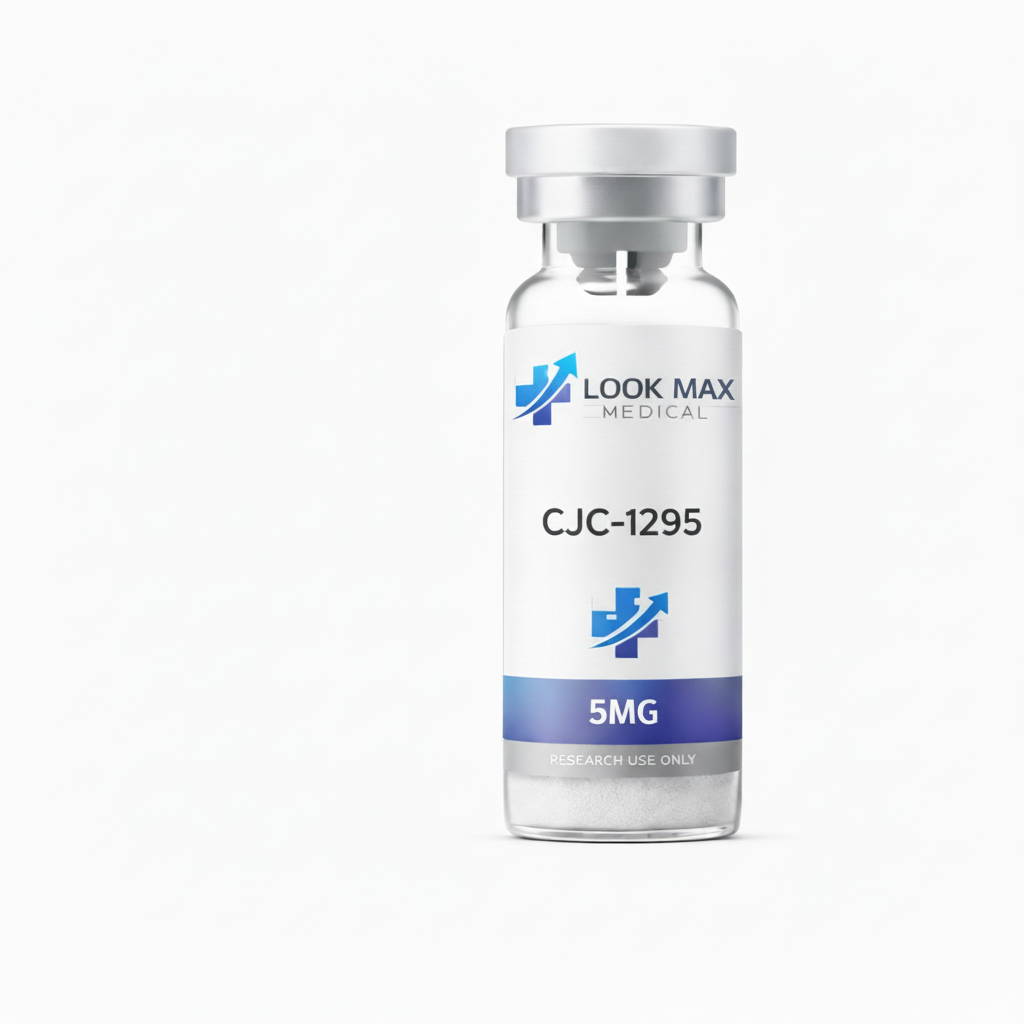
Description
GHRH Analog
CJC-1295 — Research & Data
A modified growth hormone-releasing hormone analog with extended half-life. CJC-1295 amplifies GH pulsatility and sustains elevated IGF-1 levels for days after administration.
How CJC-1295 Works
CJC-1295 binds GHRH receptors on pituitary somatotrophs, stimulating GH synthesis and pulsatile release. The DAC modification covalently binds to serum albumin, preventing DPP-IV degradation and extending the half-life from minutes to 6-8 days. The ‘no DAC’ version (mod GRF 1-29) has a shorter ~30 minute half-life for more precise pulsatile control.
Mechanisms of Action
GHRH Receptor Binding
Binds pituitary GHRH receptors to stimulate growth hormone synthesis and pulsatile release patterns.
Extended Duration
Drug Affinity Complex (DAC) modification prevents enzymatic degradation, extending bioactivity to 6-8 days.
IGF-1 Amplification
Sustained GH elevation drives prolonged hepatic IGF-1 production, supporting anabolic and recovery processes.
What Research Has Shown
Human studies show dose-dependent GH increases of 2-10 fold and IGF-1 increases of 1.5-3 fold that persist for 6-8 days after a single injection (DAC version). The no-DAC version produces acute GH pulses lasting 2-3 hours. Both versions are well-tolerated in clinical studies.
Dosing Information from Research
CJC-1295 with DAC: 2 mg subcutaneously once weekly. CJC-1295 no DAC (mod GRF 1-29): 100–300 µg subcutaneously 1–3 times daily. No DAC version is typically combined with ipamorelin for synergistic effects.
Pharmacokinetics
With DAC: half-life 6-8 days, peak GH 2-4 hours post-injection, steady state IGF-1 achieved by week 2. Without DAC: half-life ~30 minutes, peak GH 15-30 minutes post-injection, returns to baseline within 2-3 hours.
How It Works in the Body
CJC-1295 stimulates the GHRH receptor on pituitary cells, activating cAMP signaling that drives GH gene transcription and granule release. The DAC version binds albumin, creating a long-acting depot that continuously stimulates the pituitary. This amplifies both GH pulse amplitude and IGF-1 production without desensitizing the receptor.
Important Notes
- Two forms exist: CJC-1295 with DAC (long-acting) and without DAC (short-acting, also called mod GRF 1-29).
- The DAC version provides sustained GH/IGF-1 elevation but less physiological pulsatility.
- The no-DAC version is preferred when combined with GHRPs for synergistic pulsatile GH release.
Safety Profile from Research
What clinical studies report
CJC-1295 has been well-tolerated in Phase 1/2 human trials. Common side effects include injection site reactions, flushing, and transient headache. No serious adverse events were reported at therapeutic doses.
Common Digestive Issues
Mild nausea reported in <5% of subjects, typically transient.
Treatment Discontinuation Rates
Less than 3% in Phase 1/2 trials.
Study Exclusion Criteria
Patients with pituitary disorders, active malignancy, uncontrolled diabetes, or elevated baseline IGF-1 were excluded.
Researcher Notes
- CJC-1295 no DAC combined with ipamorelin is the most common GH research stack.
- The DAC version is better for sustained IGF-1 elevation; no DAC is better for acute GH pulsatility.
- Monitor IGF-1 levels to ensure they remain within physiological range during research protocols.
Compound Information
Storage Requirements
Lyophilized
Store at -20°C for long-term. Stable at 2-8°C for up to 3 months.
Reconstituted
With DAC: use within 14 days at 2-8°C. Without DAC: use within 21 days at 2-8°C.
Light Sensitivity
Moderate. Store in opaque containers or original packaging.
Research Status — Where It Stands
CJC-1295 (both variants) is extensively used in GH research. Phase 1/2 human data is published. Not FDA-approved for any indication. Active research compound.

Reviews
There are no reviews yet.