
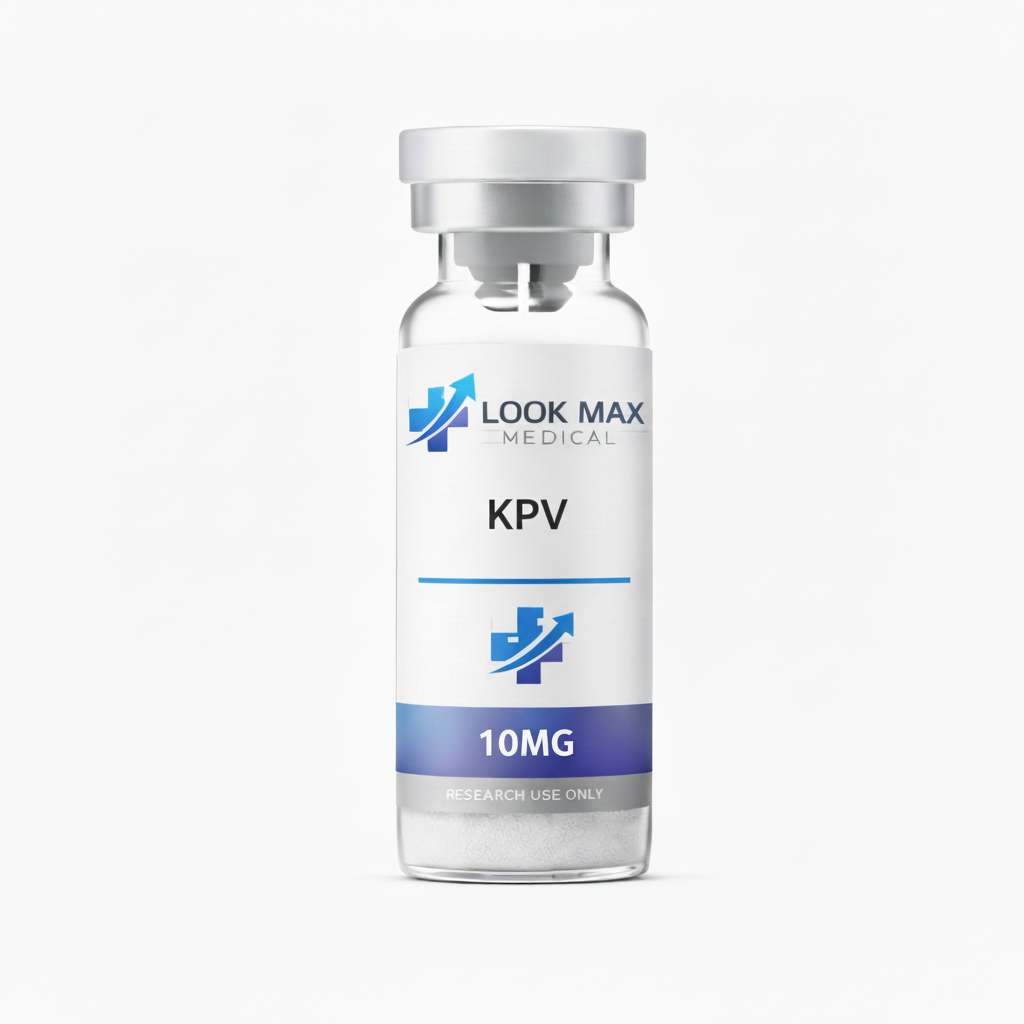
Description
Anti-Inflammatory Tripeptide
KPV — Research & Data
A C-terminal tripeptide fragment (Lys-Pro-Val) of alpha-melanocyte-stimulating hormone (α-MSH). KPV retains potent anti-inflammatory properties without melanotropic activity.
How KPV Works
KPV (Lys-Pro-Val) is the C-terminal tripeptide of α-MSH that retains potent anti-inflammatory activity through a melanocortin-receptor-independent mechanism. It enters cells directly and inhibits IκBα phosphorylation and degradation, preventing NF-κB (p65/p50) nuclear translocation. This blocks transcription of pro-inflammatory cytokines (TNF-α, IL-6, IL-1β, IL-8) at the source.
Mechanisms of Action
NF-κB Suppression
Inhibits nuclear translocation of NF-κB, reducing transcription of pro-inflammatory cytokines (TNF-α, IL-6, IL-1β).
Mucosal Protection
Reduces intestinal inflammation and supports mucosal barrier integrity in colitis models.
Non-Melanotropic
Retains α-MSH anti-inflammatory signaling without activating melanocortin receptors for pigmentation.
What Research Has Shown
Preclinical studies show KPV significantly reduces colonic inflammation in experimental colitis models, restoring mucosal barrier integrity. It inhibits NF-κB activation in multiple cell types. KPV-loaded nanoparticles showed enhanced efficacy in targeted intestinal delivery. All data is preclinical — no human clinical trials have been completed.
Certificate of Analysis
Third Party Tested
Research Areas
IBD Research
Primary focus: ulcerative colitis and Crohn’s disease models with PepT1-mediated targeting to inflamed intestinal tissue.
Skin Inflammation
Studied in contact dermatitis, cutaneous vasculitis, and wound healing models. Topical application shows efficacy.
Antimicrobial
KPV exhibits direct antimicrobial activity against Staphylococcus aureus and Candida albicans pathogens.
NF-κB Pathway
At the cellular level, KPV inhibits NF-κB at nanomolar concentrations by interacting with IκB-α, p65RelA, and Importin-α3.
Clinical Outcomes
Regulatory Status
Dosing Information from Research
Research protocols in animal models use 100–500 µg subcutaneously or orally. Nanoparticle-encapsulated oral delivery has been studied for targeted GI effects. Human-equivalent dosing is extrapolated at 200–500 µg subcutaneously.
Pharmacokinetics
KPV is a small tripeptide with rapid absorption. Estimated half-life is 20-40 minutes due to rapid peptidase degradation. Nanoparticle encapsulation extends effective half-life and enables targeted GI delivery. The small size allows intracellular penetration.
How It Works in the Body
KPV enters cells through direct membrane penetration (not receptor-mediated). Once intracellular, it blocks the IKK complex from phosphorylating IκBα, the inhibitor of NF-κB. This prevents IκBα degradation and keeps NF-κB sequestered in the cytoplasm, unable to enter the nucleus and activate inflammatory gene transcription. The result is suppression of TNF-α, IL-6, IL-1β, and other pro-inflammatory mediators.
Important Notes
- KPV works independently of melanocortin receptors — it does not cause skin darkening.
- All published data is preclinical. No human clinical trials have been completed.
- KPV’s mechanism (NF-κB inhibition) is relevant to a wide range of inflammatory conditions.
- Oral delivery via nanoparticles is an active area of research for GI-targeted applications.
Safety Profile from Research
What clinical studies report
No adverse effects reported in animal studies at research doses. KPV is a fragment of endogenous α-MSH, suggesting inherent biocompatibility. Human safety data is not available from controlled trials.
Treatment Discontinuation Rates
Not applicable — no human trials completed.
Study Exclusion Criteria
Expected standard exclusions: active immunosuppression, autoimmune conditions requiring biologics, active infections.
Researcher Notes
- KPV is one of the smallest bioactive peptides studied (only 3 amino acids).
- Its NF-κB inhibition mechanism is well-characterized and highly reproducible in cell models.
- Consider nanoparticle encapsulation for oral delivery research to protect from rapid degradation.
- KPV pairs well with BPC-157 in GI research protocols due to complementary mechanisms.
Compound Information
Storage Requirements
Lyophilized
Store at -20°C for long-term. Stable at 2-8°C for up to 6 months.
Reconstituted
Use within 14 days at 2-8°C.
Light Sensitivity
Low. Standard storage is sufficient.
Research Status — Where It Stands
KPV is in preclinical research phase with strong published data on NF-κB inhibition and intestinal anti-inflammatory effects. No human trials completed. Nanoparticle delivery systems are under development. Not FDA-approved.


Reviews
There are no reviews yet.